Mobile App Payments in Campuses vs Traditional Cash Transactions: Why Smart Institutions Are Going Cashless
Educational institutions are rapidly embracing digital technologies to create smarter, more efficient campus environments. One area experiencing significant transformation is Digital Payments in Education. Traditionally, students relied on cash for purchases in cafeterias, bookstores, libraries, transportation services, and campus events. However, Mobile App Payments in Campuses are now replacing cash transactions, offering greater convenience, security, and transparency.
As schools, colleges, and universities continue their digital transformation journey, the debate between mobile app payments and traditional cash transactions becomes increasingly relevant. This article explores the differences between these two payment methods and explains why campuses are moving toward Cashless Campus Solutions.
Understanding Traditional Cash Transactions in Campuses
For many years, cash has been the primary mode of payment within educational institutions. Students carry physical money and use it for daily expenses across campus facilities.
Common cash transaction activities include:
- Purchasing meals in cafeterias
- Paying library fines
- Buying books and stationery
- Paying transportation charges
- Registering for events and activities
While cash transactions are familiar and straightforward, they come with several operational and security challenges.
Challenges of Traditional Cash Transactions
Long Queues and Delays
During peak hours, such as lunch breaks, students often form long queues while cashiers count money and provide change. Even small delays can affect overall campus efficiency.
Risk of Theft and Loss
Cash can be misplaced, stolen, or lost. Students carrying large amounts of money are exposed to unnecessary financial risks.
Manual Record Keeping
Administrative staff must manually track and reconcile cash collections, increasing the chances of errors and discrepancies.
Limited Financial Transparency
Cash transactions leave little room for Financial Transparency in Education. Students and parents often lack visibility into spending patterns.
Increased Administrative Workload
Handling, counting, depositing, and reconciling cash requires significant staff effort and resources.
What Are Mobile App Payments in Campuses?
Mobile App Payments in Campuses allow students to make transactions using smartphones through a dedicated campus payment application. These systems may integrate with:
- UPI payments
- Digital wallets
- Debit and credit cards
- Student ID cards
- Parent-funded campus accounts
Students can pay for various campus services without carrying cash, making transactions faster and more secure.
A Real Campus Scenario
Imagine a university with over 5,000 students using a Campus Management System integrated with digital payment technology.
Traditional Cash Payment Experience
A student visits the cafeteria and purchases lunch worth ₹120.
The student:
- Searches for cash.
- Hands over ₹200 to the cashier.
- Waits for ₹80 in change.
- Experiences delays due to long queues.
At the end of the day, cafeteria staff manually count cash and prepare collection reports.
Mobile App Payment Experience
The same student uses a Student Mobile Wallet integrated with QR Code Payments.
The student:
- Opens the app.
- Scans a QR code.
- Confirms payment.
- Receives instant payment confirmation.
The transaction is automatically recorded and reflected in the Campus Management System.
Benefits of Mobile App Payments in Campuses
Faster Transactions
Mobile payments can be completed within seconds, significantly reducing waiting times in cafeterias, bookstores, and other campus facilities.
Improved Security
Digital transactions are protected through encryption, passwords, and biometric authentication, reducing the risk of theft and fraud.
Real-Time Transaction Records
Every payment is automatically recorded, providing complete transaction histories for students and administrators through Real-Time Transaction Tracking.
Enhanced Parent Visibility
Parents can monitor student spending through linked accounts and receive alerts through a Parent Notification System.
Automated Financial Reporting
Campus administrators gain access to instant reports and analytics without manual reconciliation through Automated Financial Reporting.
Better Student Experience
Students no longer need to carry cash or worry about finding exact change. Payments become seamless and convenient.
Mobile App Payments vs Traditional Cash Transactions
Transaction Speed
Cash: Slower due to counting and change handling.
Mobile App: Instant payment processing through Contactless Payment Solutions.
Security
Cash: Vulnerable to loss and theft.
Mobile App: Secure digital transactions with authentication.
Record Management
Cash: Manual tracking and reconciliation.
Mobile App: Automated transaction records within a Campus Management System.
Parent Monitoring
Cash: No visibility into student spending.
Mobile App: Real-time spending insights through a Parent Notification System.
Administrative Efficiency
Cash: High operational workload.
Mobile App: Automated reporting and reconciliation.
User Convenience
Cash: Requires carrying physical money.
Mobile App: Accessible anytime through smartphones.
Why Smart Campuses Are Going Cashless
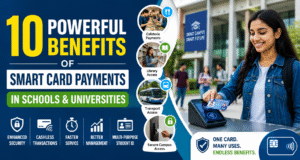
Educational institutions worldwide are investing in Smart Campus Technology and Campus Automation Solutions to improve operational efficiency and student satisfaction. Mobile App Payments in Campuses align perfectly with this vision by creating a cashless ecosystem that benefits students, parents, and administrators.
Key advantages include:
- Reduced cash handling
- Faster service delivery
- Improved financial transparency
- Better security
- Enhanced campus experience
- Data-driven decision making
Many institutions combine payment solutions with RFID Student Tracking, School Transport Management, and Student Attendance Management systems to create a fully connected campus ecosystem.
Future of Campus Payments
With the growth of digital wallets, UPI Payment Integration, and mobile banking, cashless campuses are becoming the new standard. Future campus payment systems may integrate artificial intelligence, spending analytics, and personalized financial management tools to further improve user experiences.
Institutions that adopt mobile payment solutions today will be better positioned to meet the expectations of digitally connected students and parents.
Conclusion
The comparison between Mobile App Payments in Campuses and traditional cash transactions clearly demonstrates the advantages of digital payment systems. Mobile app payments offer greater speed, security, convenience, and transparency while reducing administrative burdens and cash handling risks.
As educational institutions continue embracing Digital Transformation in Schools, mobile payment solutions are becoming an essential component of Smart Campus Technology. By adopting Cashless Campus Solutions, campuses can create a safer, more efficient, and future-ready environment for everyone.